Knitting Portraits

Ever since I started knitting, I have a tendency to look for artwork featuring either women knitting or spinning on old-fashioned wheels when visiting museums. I have been fortunate to visit both the Louvre in Paris and the Metropolitan Museum of Art (the Met) in New York. It was there that I discovered these first two paintings.

The first is called “By the Seashore” by Auguste Renoir on display at the Met. The woman is beautiful with her ruddy cheeks and penetrating eyes. According to the museum catalog, Renoir most likely painted this portrait in his studio and rendered the images of the sea and cliffs from memory. There is a distinct difference between the clear outlines of the woman (his mistress and later his wife) and the looser brushstrokes of the landscape behind her. After her gaze, I noticed the items in her hands – a knitting needle and something she is working on.
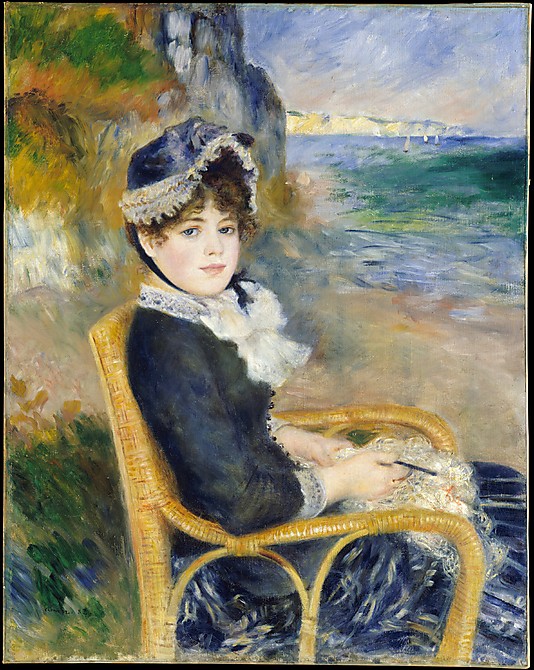
By the Seashore by Auguste Renoir
1883 – Oil on canvas

{source}

This next painting, “The Lacemaker” by Johannes Vermeer, is at the Louvre. Her face is so intently focused on her craft that it draws my eyes to her hands. My eyes then rest on the pillow with the loose threads spilling over.
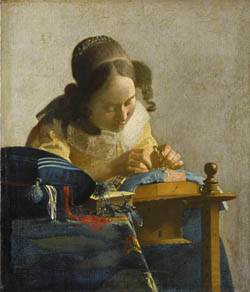
The Lacemaker by Johannes Vermeer
c. 1669-70 – Oil on canvas

{source}

I wish I could see this next one in person but it is in a private collection. The painting is “Young Woman Knitting” by Vincent Van Gogh. The girl stands out against the barren room. I am immediately entranced by the deep blues of her apron. The colors are in direct contrast to the browns of the floor and walls. You can just see her yarn trailing along her skirt to the ball on the floor. The scene feels so familiar.
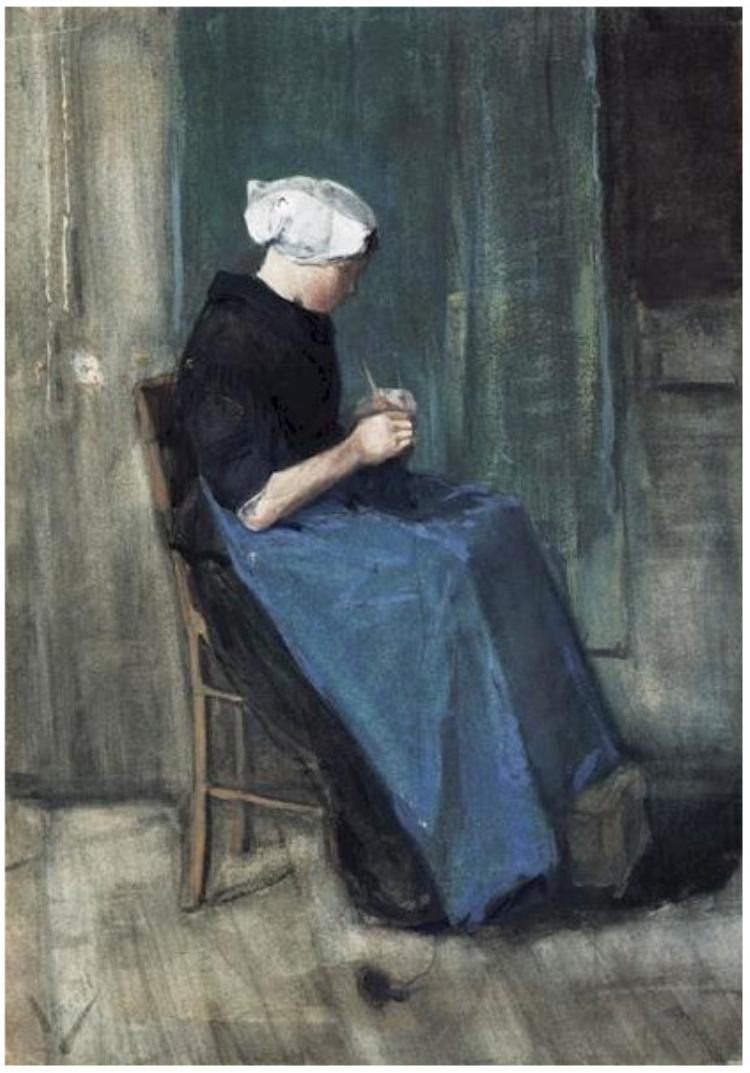
Young Woman Knitting by Vincent Van Gogh
1881 – Watercolor

{source}

This last painting is “Girl Sitting in the Garden” by Edouard Manet, also in a private collection. You can hardly see the girl’s face hidden under her hat as she watches her knitting. Even the knitting is loosely implied against the gray of her dress accented by that blue bow and the greenery in the garden.
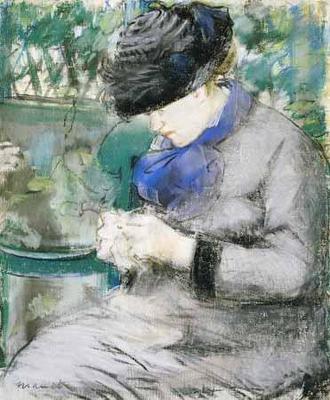
Girl Sitting in the Garden by Edouard Manet
1879 – Pastel on paper

{source}

If you were to google “paintings woman knitting,” many other options will present themselves. I like these and hope one day to see them again or for the first time in person.
Pear Humor

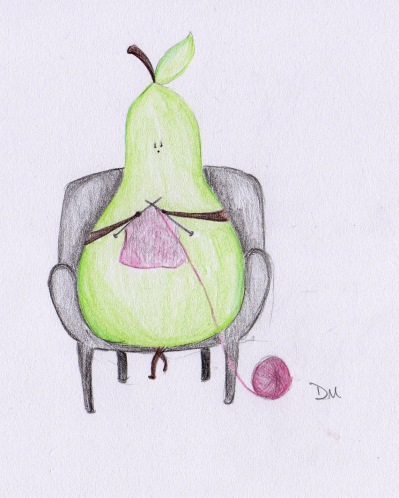
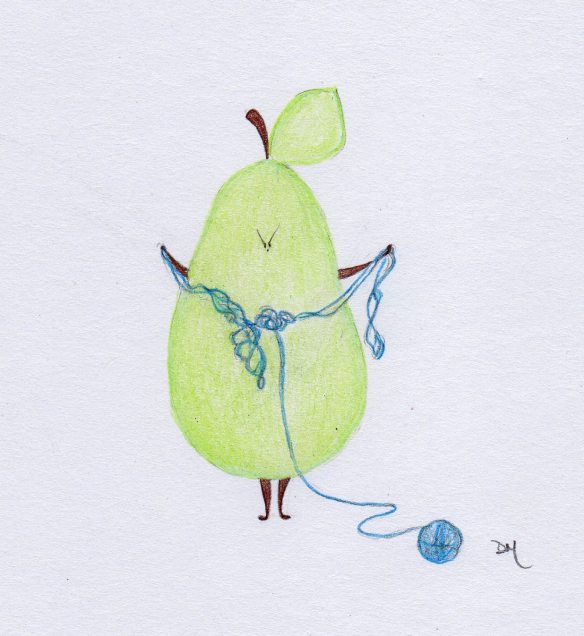
I don’t recall how I came across Angry Pear but I was hooked. I can’t help but chuckle at Angry Pear’s antics. For a fruit with such a small face, this Pear can be quite expressive! And why is Pear so angry anyway?

I have chosen my two favorite drawings to share because they just so happen to be about knitting.

Knitting Pear
Knitting Woes

Thanks to Drew McKevitt, the artist (and a knitter, by the way), for giving Agujas permission to post her artwork. Stop by Angry Pear whenever you need a smile. And be on the lookout for another Angry Pear knitting mishap.

Huichol Yarn Art

Some time ago, my husband and I made a backpacking trip to Real de Catorce, which is located near Matehuala. Matehuala is significant only in that it marks roughly the half-way point between the U.S.-Mexico border and Mexico City. It was one of those cross-country bus, non-air conditioned van, and back of pick-up truck kind of trips. (Yes, I know, first class all the way).

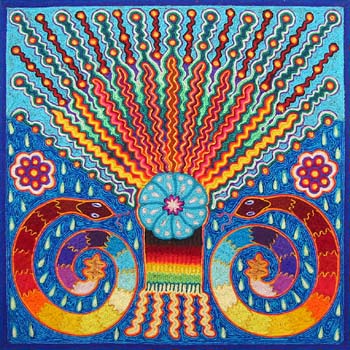
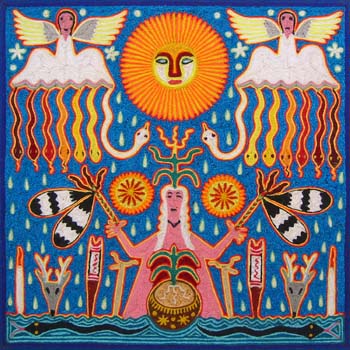
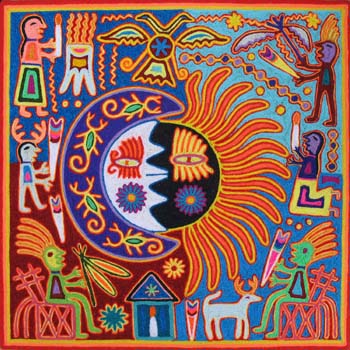
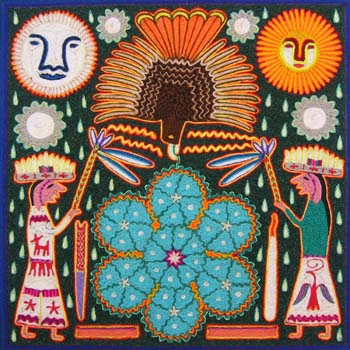
Real de Catorce is an old silver mining town located about 2,750 meters (9,000 feet) above sea level in the Sierra de Catorce, close to the Tropic of Cancer. The area is home to the Huichol Indians. They can be seen in traditional dress throughout the town and selling their arts and crafts in the markets. One of their crafts involves creating exquisitely detailed and colorful paintings using yarn. The yarn paintings reflect their religious beliefs and aspects of nature that comprise their cosmology.

When I visited, I did not take pictures of the Huichol or of their art so I found examples of their art online. The following four yarn paintings came from here. In them, you will find the visions of the Shaman, nature and deities, snakes, eagles, deer, an eclipse, the peyote, and corn, among others.

The central figures in this next yarn painting are the eagle looming overhead flanked by the sun and the moon while the bottom half features the peyote. The peyote is  a kind of cactus with hallucinogenic properties. The peyote is a sacred plant to the Huichol and the cultivation and gathering of the plant is controlled to prevent extinction and misuse.

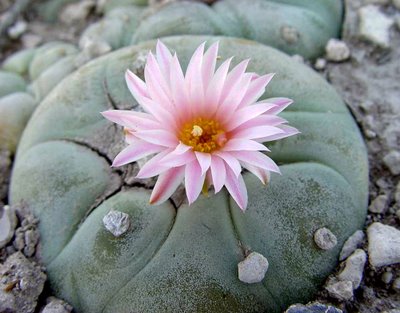
This is what peyote looks like in the wild.

{source}

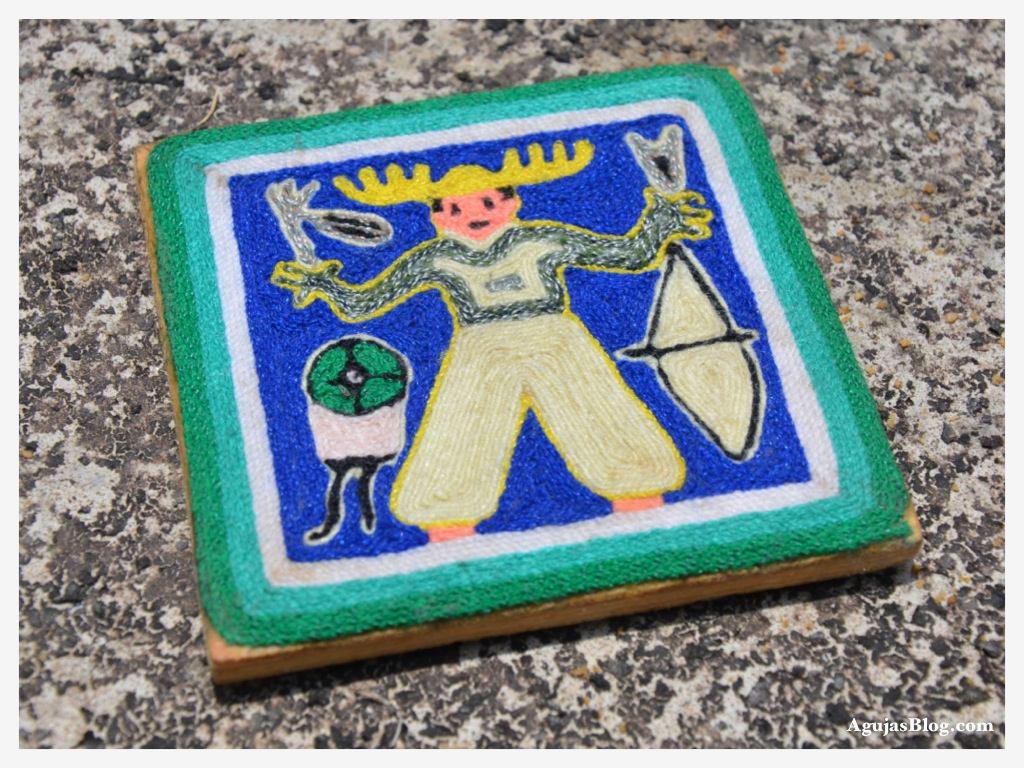
I did bring home this small 4×4 inch yarn painting (small items I could stash in the backpack). The painting is of “Hombre Chaman de Mucho Conocimiento” or “Shaman Man of Much Knowledge” and is signed by the artist, Alejandro López Torres. In it you can appreciate the winding of the yarn on the wood to create the image.

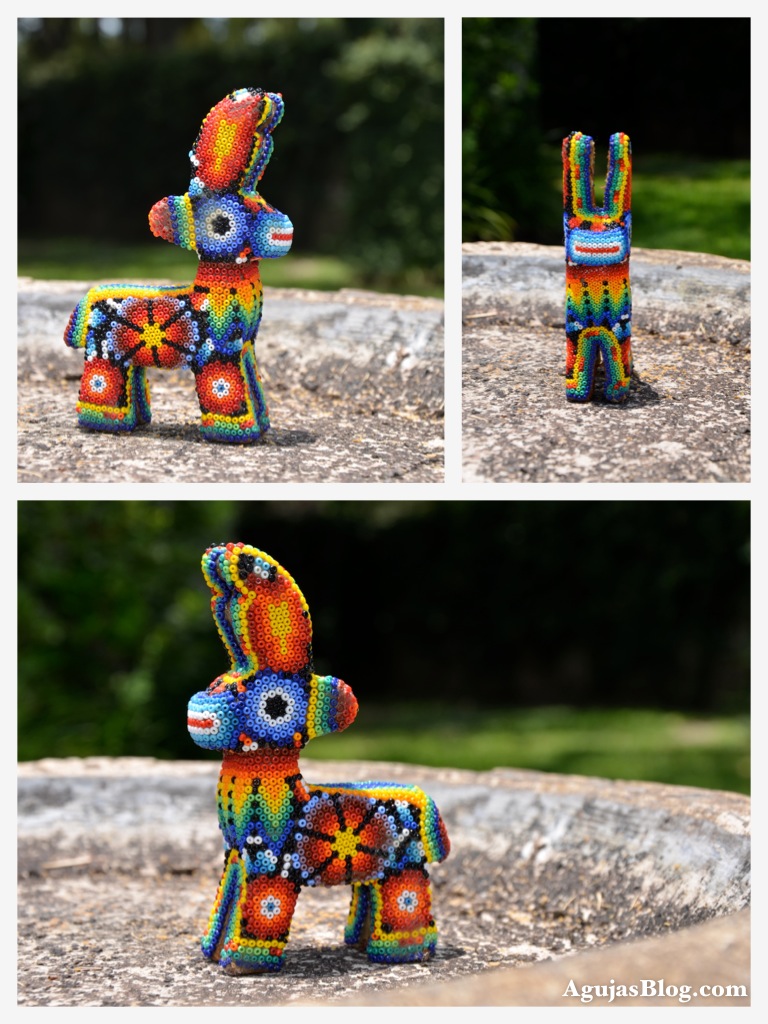
Another Huichol craft uses extremely tiny beads to create jewelry and decorate animals carved from wood. The beaded carvings are usually of animals revered by the Huichol, like this tiny deer (stands 4 1/2 inches tall).

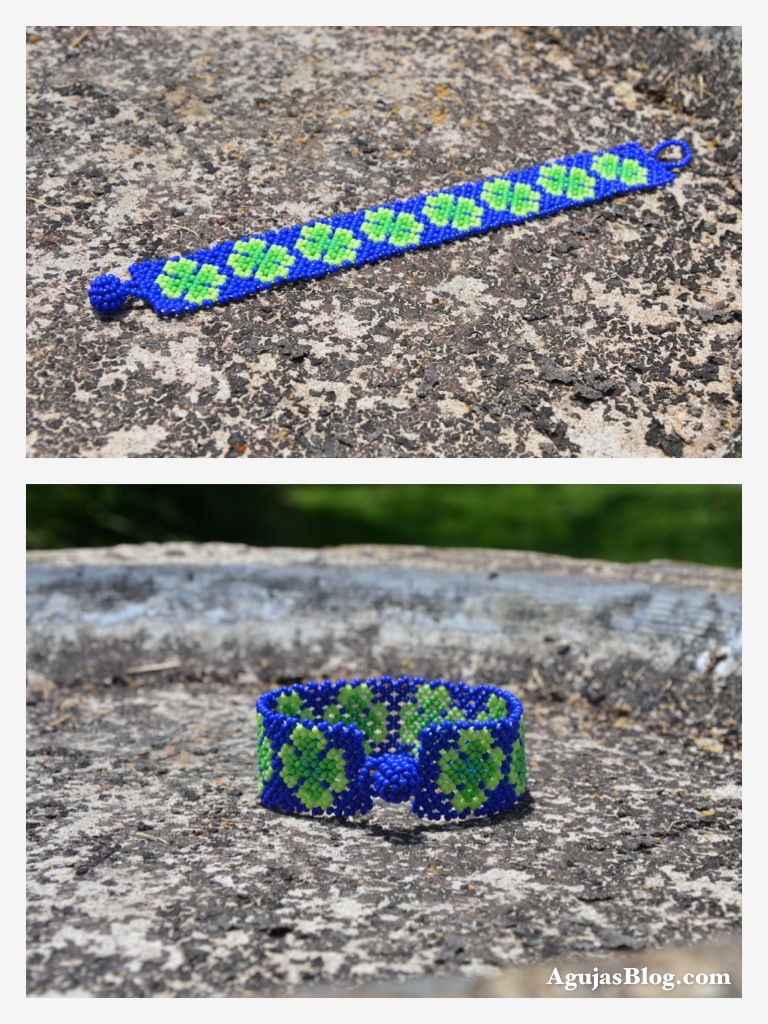
Here is a beaded bracelet I brought home. The main motif is the peyote.

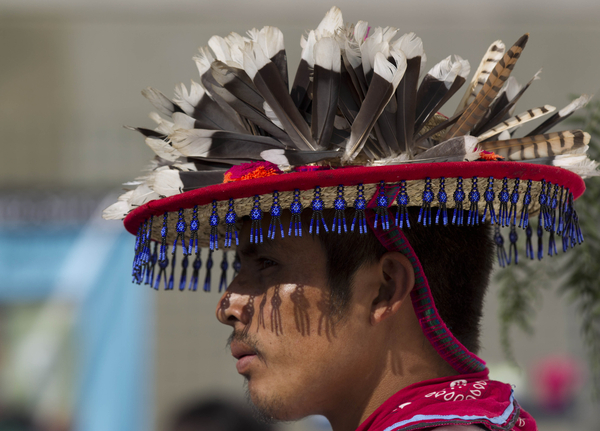
In the process of writing this post, I learned that a few days ago there was a huge gathering of Huichol Indians in Mexico City for Wirikuta Fest 2012. Wirikuta is another name for the Huichol. The music festival featured famous singers and musicians including Café Tacvba and Julieta Venegas, two of our favorite artists. The festival was held in support of the Huichol Indians who are fighting the encroachment of mining on their lands. The following pictures of Huichol in traditional dress were taken at the festival and can be found here (slides 18 & 19).

Stay tuned for a post about Real de Catorce.